Source-free RC Circuit
RC circuits are made of a resistor and a capacitor. When the circuit is source-free, it means there is no external voltage or current source connected to the circuit. That is, after the energizing source is removed, the circuit will continue to operate based on the energy stored in the capacitor. As such, this circuit can be described with a first-order linear differential equationA differential equation that contains only the first derivative of the unknown function (for example, dv/dt)..
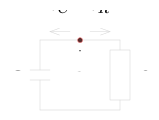
For starters, assume the function of voltage, , at time is . This is important for later. At any time , the current through the capacitor and resistor is:
Applying KCL at the top node gives us:
Substituting the expressions for and gives us:
Rearranging gives us the first-order linear ODE:
This ODE is of the form , where and (see here for notes on the integrating factor method).
The integrating factor is thus:
Multiplying both sides of the ODE by the integrating factor gives us:
Recognize that the left-hand side is the result of the product rule (the coefficient comes from differentiating ), so can be rewritten as:
Now, integrating with respect to gives:
Finally, we can solve for :
C is a constant that can be solved for using an initial condition. For example, if we know that , then we can solve for :
Thus, the solution to the ODE is (with as per electrical engineering convention):